Two broken Tigers on fire in the night
flicker their souls to the wind
We wait in the lines for the final approach to begin
It’s been almost four years that I’ve carried a gun
At home it’ll almost be spring
The flames of the Tigers are lighting the road to Berlin
Ah, quickly we move through the ruins that bow to the ground
The old men and children they send out to face us,
they can’t slow us down
And all that I ever was able to see
The eyes of the city are opening now, it’s the end of the dream
— Al Stewart, from “Roads to Moscow”
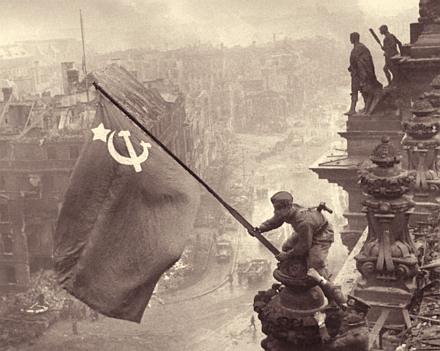
On May 8, 1945, Soviet troops entered Berlin, quickly wiping out the last German resistance whilst looting and raping amid the ruins of a once-proud city.
To the surviving residents of Berlin, it must have seemed that Götterdämmerung — which was what Hitler had predicted if the German people failed him and the Nazi cause — had indeed arrived. Ten years previously, or even five years previously, it would have been unimaginable that the great and glorious Third Reich would ever come to this.
Western Civilization is rapidly approaching the point when it will have to awaken from its own dream. But the analogy with the end of Nazi Germany is not particularly apt, since the Third Reich existed for a mere twelve years. And the crucial period of modern history, in which Europe was all but destroyed, lasted for only thirty-one years: from June 28, 1914 until the summer of 1945.
The origins of the Dream of the West may be traced to various dates, depending on the ideological lens through which the past is scrutinized. Did our current Weltanschauung begin with the American Revolution in 1776? The French Revolution in 1789? Or should we move further back, to the Treaty of Westphalia in 1648?
Americans may want to assign the birth of our current behemoth to the creation of the Federal Reserve in 1913. Europeans might trace their modern system to the Congress of Vienna in 1815, or to the novel nationalist-democratic arrangements that emerged after the Revolutions of 1848.
In any case, the order which is now coming to an end is at least a century old, and probably much older. Its history encompasses the codification of the sovereign nation-state, the emergence of nationalism, the (often reluctant) transition to modern democracy, the creation of the socialist welfare state, and finally the invention of the “fiat money” system to pay for the rest of it.
Our venerated cultural order will breathe its last within a generation. Whether it departs the scene with a bang or a whimper, it must needs give way to something else, a different way of ordering society. Its collapse is mathematically inevitable, for it is a house built upon the sand.
And the rain descended, and the floods came, and the winds blew, and beat upon that house; and it fell: and great was the fall of it.
— Matthew 7:27
In the comments on Wednesday’s post “Punching Down”, an anonymous commenter left the following observation:
Every now and then when I think about it, I’m astonished again by the fantasy world in which the European elites must dwell.
It must be a fantasy that they hold to with religious fervor. Otherwise, how could one account for the fact that they act as if they do not care what kind of world they leave for their children and grandchildren?
Not that our American counterparts are much better.
Yes, the fantasy is coming to an end. The political and cultural leaders of Europe, North America, and Australia share the same dream. Those at the highest levels of government and business generally view themselves as a trans-national ruling class with no great attachment to any single nation or people. Their collective dream is one of global governance — presided over by themselves, of course — propped up by a financial system that keeps power in the hands of the oligarchs who run it, and prevents any serious irruption from “the mutable, rank-scented many” beneath.
The fall of a system as extensive, wealthy, powerful, and well-entrenched as ours will be catastrophic in scope. Rather than the end of the Third Reich, the fall of the Roman Empire provides an event of comparable historical significance.
The fall of Rome was a slow-motion process that took place over several centuries, even though it appeared rapid in hindsight a millennium later. The collapse of the Westphalian Order may occur more suddenly, given the existence of instantaneous worldwide communication networks. Alternatively, we may be in for a gradual descent into poverty, social degradation, and disorder, followed by the emergence of a new order whose form cannot yet be imagined.
Yet the change will come. The leaders of the Western democracies are in deep denial, for they have driven their countries so far into debt that the bill can never be paid off. As is true of all Ponzi schemes, the collapse of the current fiat money regime is a mathematical certainty. The only question is when it will happen.
The Roman Empire depended for its political hegemony on the strength and discipline of its legions, which conquered new territories and then garrisoned them as they were incorporated into the Empire. The well-being of the center depended on taxation and slavery, both of which institutions were maintained by soldiers sent from Rome.
In our modern transnational imperium, what is analogous to the Roman legions?
 The American military is obviously crucial to the maintenance of international order, but it hardly accounts for the success of, say, the European Union in subduing its citizenry and suppressing any significant dissent. The EU can scarcely muster more divisions than were proverbially available to the Pope, yet it manages to control its subjects with unprecedented efficacy. Stalin and Mao could only dream of ruling over such a passive and compliant populace. To a lesser extent, the same is true of the political order in the United States, Canada, and Australia.
The secret of our rulers’ success lies in the combined carrot-and-stick incentives provided by the all-encompassing welfare state. Compliant citizens are rewarded with short working hours, subsidized amenities of all kinds, long paid vacations, “free” health coverage, and early retirement. Dissenters may be ruthlessly suppressed by the withdrawal of some or all of these perquisites, augmented by various forms of official harassment whose Kafkaesque intricacies are made possible by the technological ingenuities of a bloated state bureaucracy.
The system is further strengthened through state-sponsored propaganda, which once again is made devastatingly effective through modern technology, especially television. Indoctrination begins early in state crèches and kindergartens, intensifies in school, and reaches a baroque extreme at the university level.
The necessity for such programming is underlined by the hostility of all Western governments to home-schooling, which is outlawed entirely in some countries. The state cannot tolerate parental guidance of children, because adults — some of whom are less than fully programmed — cannot be relied upon to indoctrinate their offspring properly in the attitudes and habits that serve to maintain the system.
The result over a period of three or four generations has been to create an ill-educated, infantile, and atomized populace. The impulses to community and national solidarity have been stunted, making it difficult for dissatisfied and demoralized citizens to band together to change their circumstances.
All of the above serves to add to the wealth and the power of the elites who administer the bureaucratic and financial behemoth that drives the system. Yet it has also contributed to the demographic implosion that will make itself felt over the next generation or so. The skilled and compliant worker-bees who maintain the current order are dying out. Their replacements, who have been imported into Western countries en masse over the last thirty years, are neither skilled nor compliant. The existing order thus becomes unsustainable.
The system now depends on ever-increasing debt, at both the personal and the national level. Individuals mired in debt postpone having children, or fail to have them at all, knowing that the state has promised to take care of them in their old age. The state itself must devise more and more ingenious and occluded ways of borrowing money to maintain and increase its power. We have now reached the point where the collective debt of the Western democracies far exceeds the wealth-creating abilities of the current generation, or the next, or the one after that.
It doesn’t take a mathematician to predict that such a system is bound to end in a major FAIL. The collapse may proceed gradually, or it may arrive suddenly, but come it must.
Yet, based on the analogy with the Roman Empire, the collapse of the current order does not portend the end of the world. As Fjordman points out, it simply means the end of the world as we know it.
The parallels between the current period and the decline of Rome are interesting and instructive, and I hope to examine them more fully in a later essay.


 Posts
Posts


No comments:
Post a Comment